The Iwo Jima Flag Raising: A Moment That Lifted a Nation
February 21, 2026
Some moments last longer than the sound that surrounds them. They rise above the smoke, the fear, and the chaos, and they settle into history not because they were planned, but because they were necessary.
On February 23, 1945, on a small volcanic island in the Pacific, six exhausted Marines raised an American flag atop Mount Suribachi. They did not think about history. Survival filled their thoughts. Questions lingered about whether the enemy was still watching from hidden tunnels, and they concentrated on the next step, the next breath, the next moment.
What they did in those few seconds became one of the most powerful images ever captured. The moment grew into a symbol of unity. It stood as a symbol of sacrifice. And it inspired hope when hope felt impossibly far away.
The true story of the Iwo Jima flag raising reaches far beyond the photograph that captured it. It lives in the hearts of those who fought below it, and in the generations who would later look at that image and feel something stir inside them.
A Battlefield Made of Ash and Fire
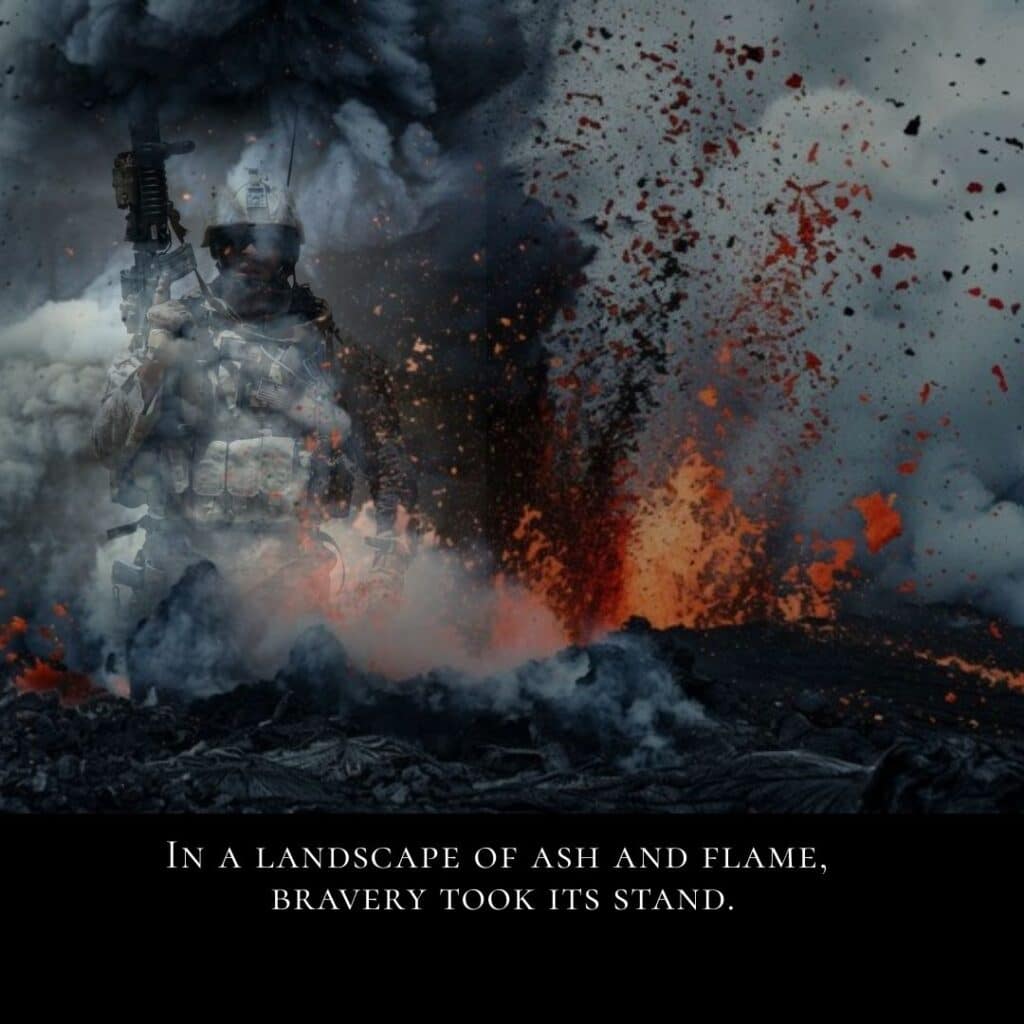
Iwo Jima was never meant to be remembered as a place of beauty. It was a blackened island of volcanic sand, sharp rock, and sulfur thick enough to burn the lungs. The ground swallowed boots. The air carried the sound of artillery and screams. Every step forward came at a cost.
The Marines who landed on Iwo Jima faced an enemy that did not retreat. Japanese forces dug deep into the island, building tunnels and fortified positions that turned every inch into a killing ground.
There was no safe direction to move. There was no clear victory in sight.
Casualties mounted quickly. Friends disappeared in flashes of fire and falling sand. Medics ran until they collapsed. Leaders fell and others stepped forward without hesitation. The island did not care who was brave or afraid. It demanded everything.
By the time American forces reached Mount Suribachi, they had already lost thousands. Exhaustion had settled into their bones. Yet Suribachi mattered. It loomed over the island, a constant reminder that the enemy still held the high ground.
The First Flag and the Meaning of Seeing It
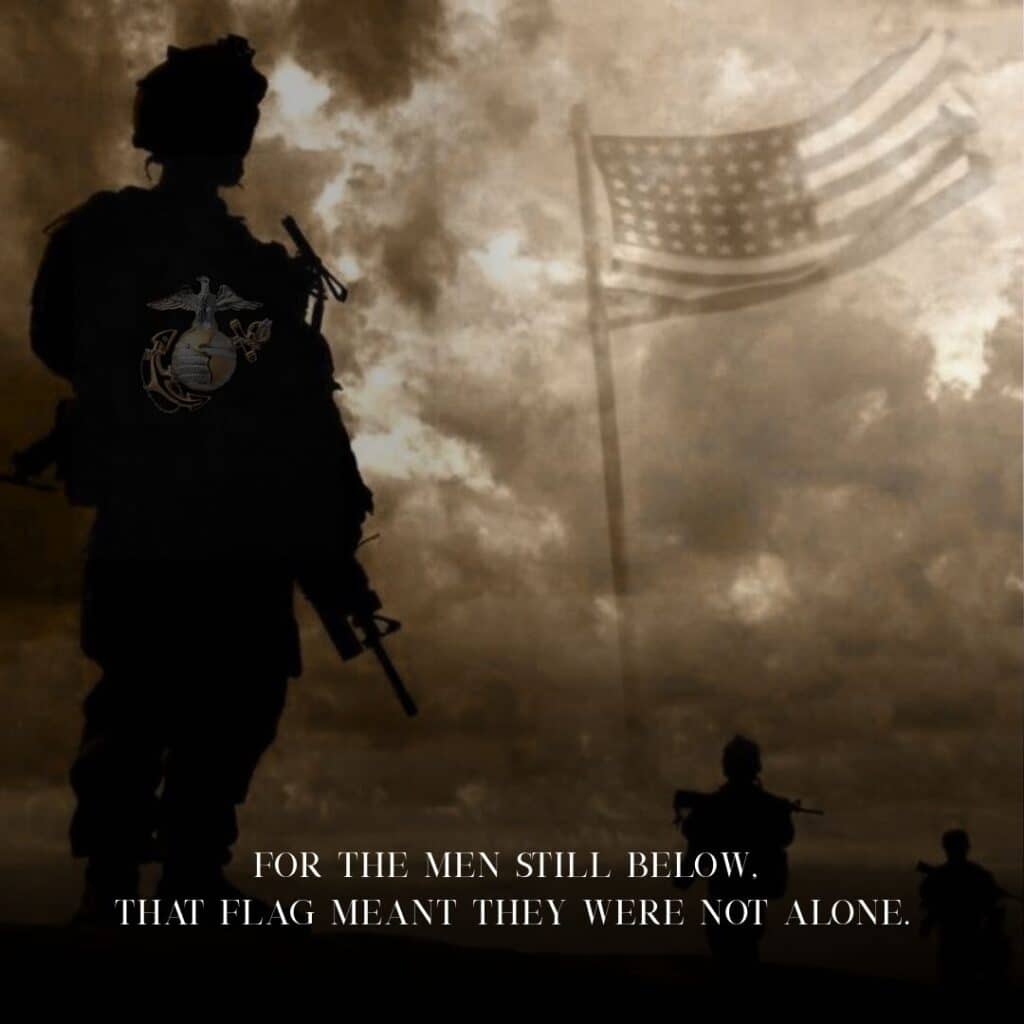
When Marines reached the summit of Mount Suribachi, they raised a small American flag. From the beaches below, thousands of Service Members saw it snap in the wind. Cheers erupted across the island. Men who had been silent for days shouted. Some cried. Some simply stood still and stared.
For a moment, the island felt lighter.
That first flag was not about celebration. Instead, it brought reassurance. Moreover, for those still fighting, it signaled that progress was possible and revealed that the mountain that had loomed over their suffering was no longer untouchable.
Command requested a larger flag so Service Members across the island could see it from farther away.
Not for glory, but for morale. The war was far from over, and the men below needed something to hold onto.
The Photograph That Carried a Nation
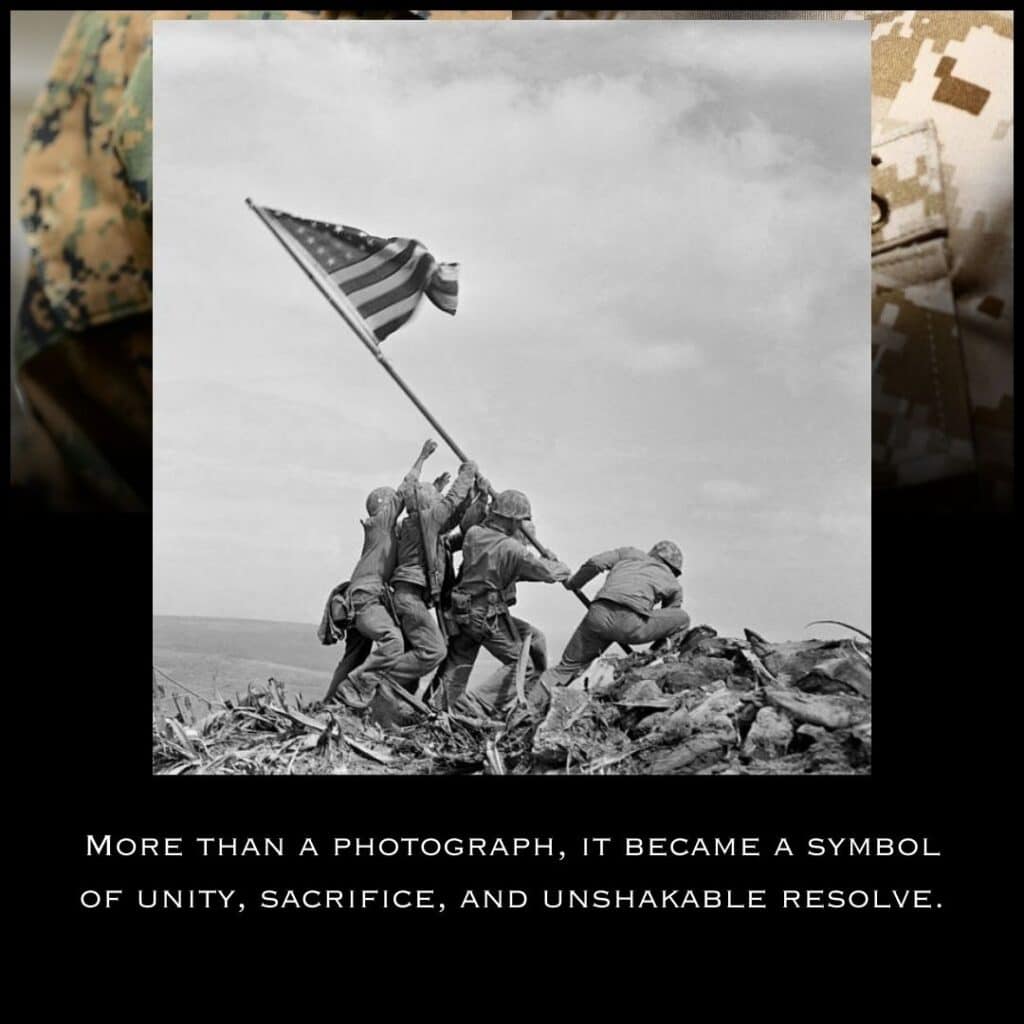
Six Marines took on the task of raising the second flag. As they struggled together against the wind and uneven ground, photographer Joe Rosenthal captured the moment without staging or direction. There was no pause. No pose. No awareness of history unfolding.
The image showed strain and unity. No faces. No single hero. Just bodies leaning together, pushing upward, bound by purpose.
When the photograph reached the United States, it spread like wildfire. Newspapers printed it across their front pages. Families stared at it in silence. War bond drives used it as a rallying cry. A weary nation found something solid in that image.
It was not a picture of victory. The battle for Iwo Jima would continue for weeks. Thousands more would die. But the photograph reminded Americans why they endured. It reminded them that their sons, brothers, husbands, and fathers were holding the line together.
The Cost Behind the Symbol
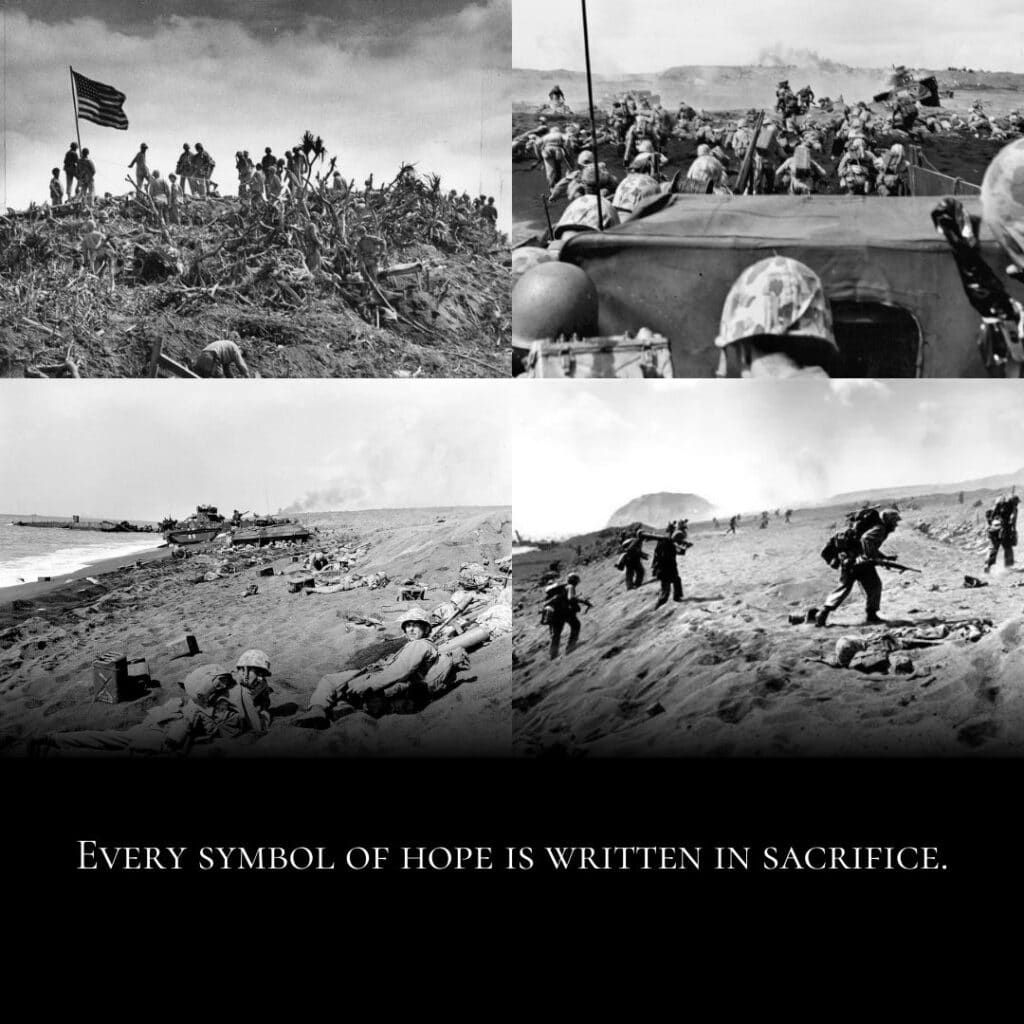
Three of the six Marines in the photograph would be killed before the battle ended. They never knew the impact of the image. They never knew how deeply it would embed itself into American memory.
Those who survived struggled with a different burden. Returning home, they were hailed as heroes yet haunted by those who did not come back. Memories lingered that no applause could erase, and they carried the truth that history often forgets. Those moments of inspiration are built on unthinkable loss.
The flag raising did not end the battle. It did not erase grief. It did not bring peace overnight. What it did was give meaning to sacrifice. It shaped courage that statistics and timelines might have otherwise erased.
Why the Image Still Matters
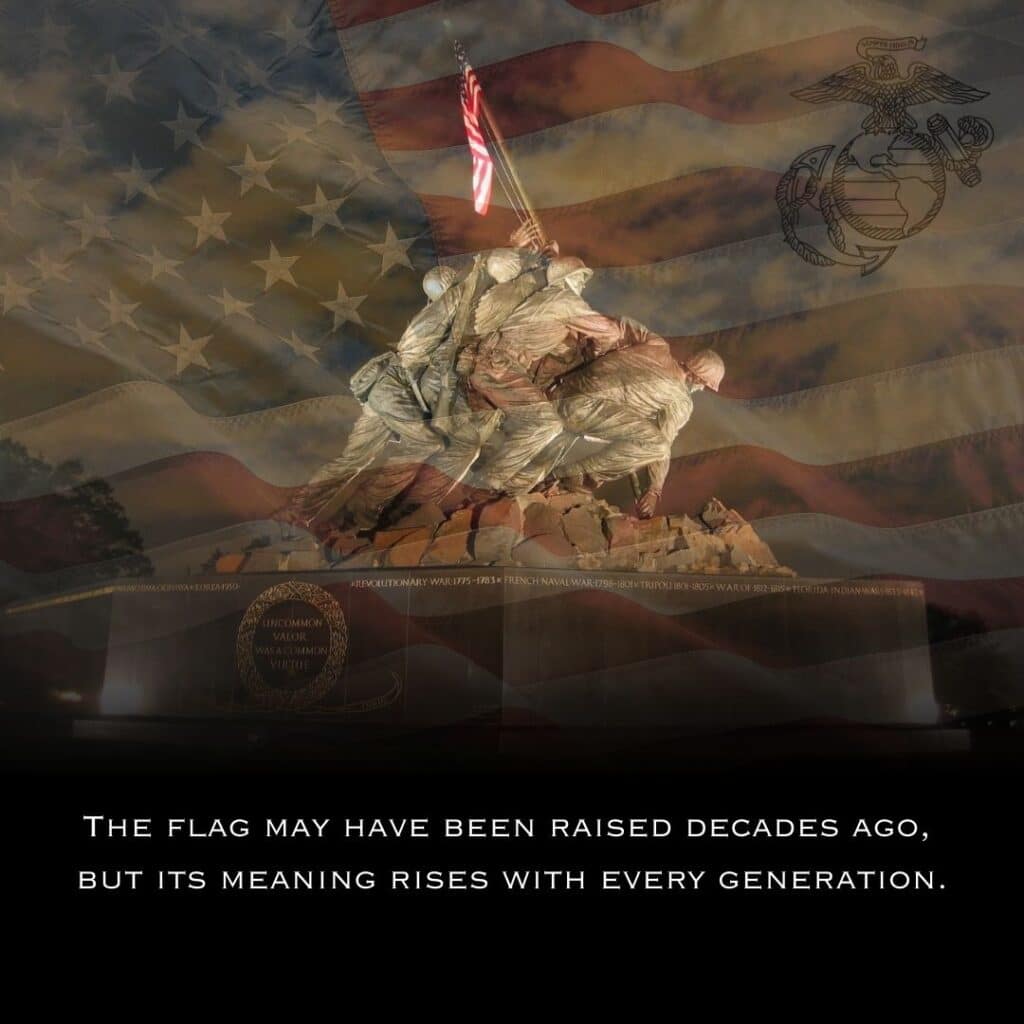
Decades later, the Iwo Jima flag raising still speaks to people who were not alive when it happened. It appears in textbooks, memorials, and quiet moments of reflection. It is carved into stone at the Marine Corps War Memorial, where it stands against the sky as a reminder of what unity looks like under pressure.
The power of the image lies in what it does not show. The photograph does not show fear, yet fear was there. Grief does not appear, but it fills the island. Hesitation is absent because pausing was no longer an option.
It shows what happens when individuals choose each other over themselves.
In a world that often celebrates personal achievement, the flag raising reminds us that some victories are only possible together. That leadership is sometimes silent. That heroism often looks like simply refusing to let go.
A Legacy Carried Forward
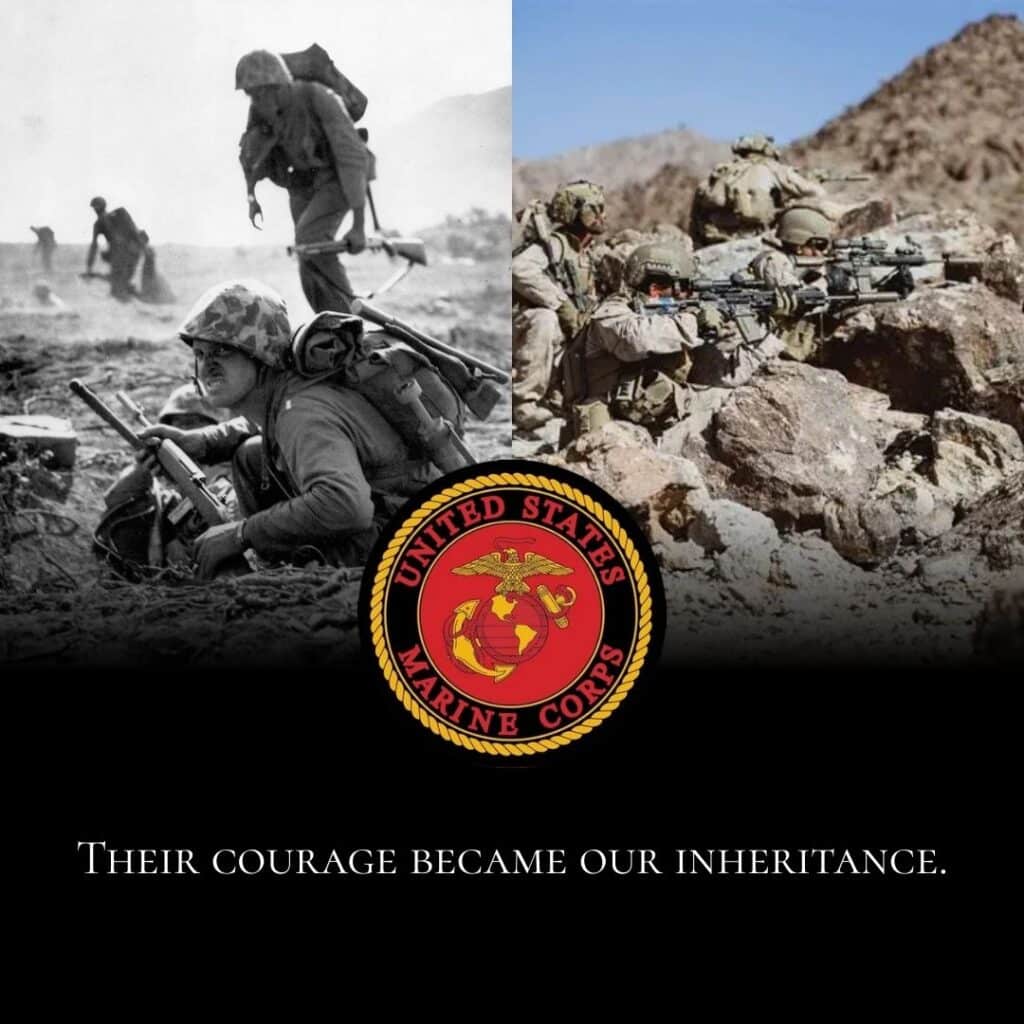
The Marines at Iwo Jima did not raise the flag for fame. They raised it because it mattered to the men below them. They raised it because it meant something in a place where so much had been taken.
Today, that moment challenges us to consider what we raise up in our own lives. What do we stand for when things are hard. Who do we lean on when the ground gives way. How do we honor those who carried burdens so we could inherit freedom.
The Iwo Jima flag raising is not just a story of war. It is a story of resolve. It is a reminder that even in the darkest conditions, people can choose unity over fear and purpose over despair.
The flag still flies, not because it was planted on a mountain once, but because its meaning continues to rise in every generation that remembers the cost of lifting it.
And as long as that memory endures, the moment on Mount Suribachi will never truly fade.
About The Author

Mike Isaac-Jimenez is a 25-year U.S. Air Force Veteran based in San Antonio, TX. He currently serves as a Marketing and Communications Veteran intern with Soldiers’ Angels, where he shares his passion for storytelling with his dedication to honoring military service. Mike holds a B.S. in Technical Management (Project Management) from Embry-Riddle Aeronautical University, along with A.A.S. degrees in Mechanical & Electrical Technology and Mechanical Engineering. He writes to preserve the legacies of America’s heroes and honor those who served and are still serving.