Jumping Into History: Honoring America’s Airborne Heroes
August 14, 2026
Some warriors charge into battle. Others fall from the sky.
The engine roars as the aircraft cuts through the morning sky, carrying young Americans toward a destination no one can guarantee they’ll survive. Above the open door, the red light glows while the fuselage vibrates with every gust of wind. Inside, there are no speeches, no applause, and no dramatic music. Only the sound of pounding hearts, the tightening of parachute straps, and the quiet understanding that in a matter of seconds, everything will change.
The jumpmaster rises for one final inspection before looking toward the door.
The light turns green.
One by one, they disappear into the sky.
For most people, stepping away from safety is unthinkable. For America’s Airborne Soldiers, it is where history begins.
Every year on August 16, our nation celebrates National Airborne Day, honoring the men and women who volunteered to do what few others would. It is more than a tribute to parachutes or military tactics. It is a celebration of Americans who chose courage over comfort, uncertainty over security, and sacrifice over self. Long before they touched the ground, they had already proven something extraordinary. They had willingly stepped into the unknown for a cause greater than themselves.
A Leap of Faith That Changed Warfare
Before America’s Airborne Forces existed, military leaders around the world searched for new ways to overcome heavily fortified enemy defenses. Tanks could be stopped. Ships could be blocked. Infantry could become trapped behind miles of obstacles. But what if Soldiers could simply fly over them?
At the time, the idea sounded almost impossible. Jumping from an airplane into combat seemed reckless, dangerous, and far too unpredictable to become a legitimate military strategy. Yet history has always favored those willing to challenge conventional thinking.
On August 16, 1940, the United States Army officially created its first experimental parachute test platoon at Fort Benning, Georgia. Only forty-eight volunteers stepped forward to become America’s first paratroopers. They were not promised medals or recognition. They were simply asked to attempt something no American military force had ever done before.
Those forty-eight men unknowingly became the foundation of every Airborne unit that followed. Because of their courage, President George W. Bush later proclaimed August 16 as National Airborne Day, ensuring their legacy would never be forgotten.
Every Airborne Soldier who earns silver wings today carries a piece of those original forty-eight with them.
Earning the Right to Wear the Wings
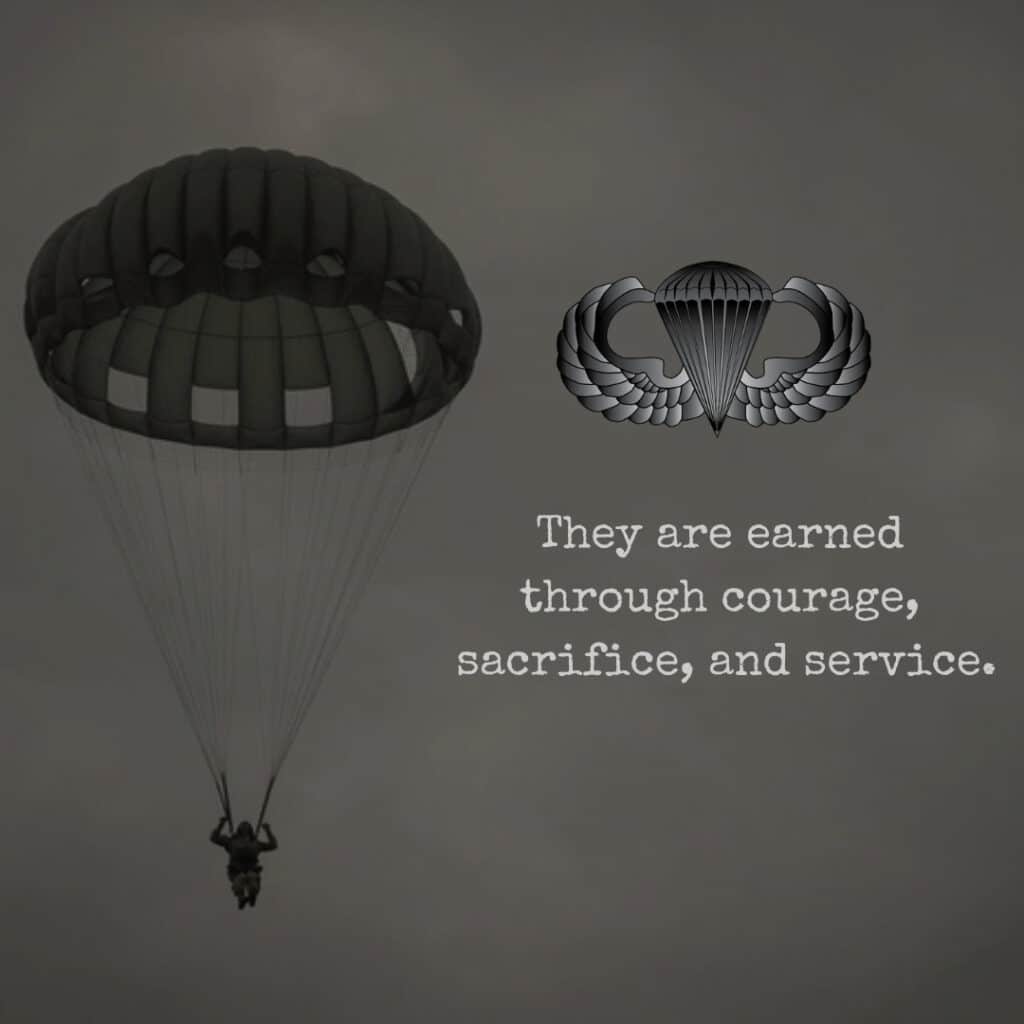
No one is given Airborne wings.
They are earned through determination, discipline, and an unwavering refusal to quit.
From the moment Soldiers arrive at Airborne School, they are pushed physically and mentally. Every exercise, every landing drill, and every repetition serves one purpose: preparing them for the moment instinct tells them not to move.
Human nature says stay inside the airplane.
Training teaches them otherwise.
Over three demanding weeks, future paratroopers learn how to exit an aircraft, control their parachute, prepare for unpredictable landings, and react when things do not go according to plan. Because in combat, perfect conditions rarely exist.
By graduation, each Soldier has completed multiple qualifying jumps and earned one of the military’s most respected symbols.
Silver wings.
Small enough to fit on a uniform.
Powerful enough to represent a lifetime of courage.
Those wings symbolize far more than completing a school. They represent a commitment to go wherever the mission demands, regardless of danger.
The Night the Sky Filled with Heroes
If there was ever a moment that proved the value of America’s Airborne Forces, it came during World War II.
On the night before D-Day, thousands of American paratroopers climbed aboard transport aircraft knowing they would be dropped behind enemy lines in occupied France. Their mission was unlike anything the world had ever witnessed. They would land in darkness, miles from friendly forces, surrounded by enemy troops, with no guarantee they would ever regroup.
Many landed far from their designated drop zones. Some found themselves alone. Others landed in flooded fields, tangled in trees, or under immediate enemy fire.
Chaos became the battlefield.
Yet something remarkable happened.
Instead of waiting for orders, scattered paratroopers formed small fighting groups wherever they landed. Officers led privates. Privates led officers. Rank mattered less than the mission. Together they destroyed bridges, captured crossroads, disrupted German communications, and sowed confusion throughout enemy defenses.
They didn’t wait for perfect conditions.
They became the plan.
Their actions played a vital role in the success of the Normandy invasion and forever secured the reputation of America’s Airborne Forces as some of the toughest Soldiers ever to wear the nation’s uniform.
All the Way
World War II was only the beginning.
America’s Airborne Soldiers continued answering the nation’s call during Korea, Vietnam, Operation Just Cause, Desert Storm, Operations Enduring Freedom and Iraqi Freedom, along with countless peacekeeping and humanitarian missions across the globe.
Sometimes they parachuted into hostile territory. Sometimes they arrived to protect innocent civilians. Sometimes their very presence prevented larger conflicts from unfolding.
No matter the mission, one truth remained constant.
When America needed Soldiers somewhere quickly, Airborne answered.
Their motto says it best.
“All the Way.”
It is more than a phrase shouted during training. It is a promise to never stop until the mission is complete.
The Brotherhood Forged in the Sky
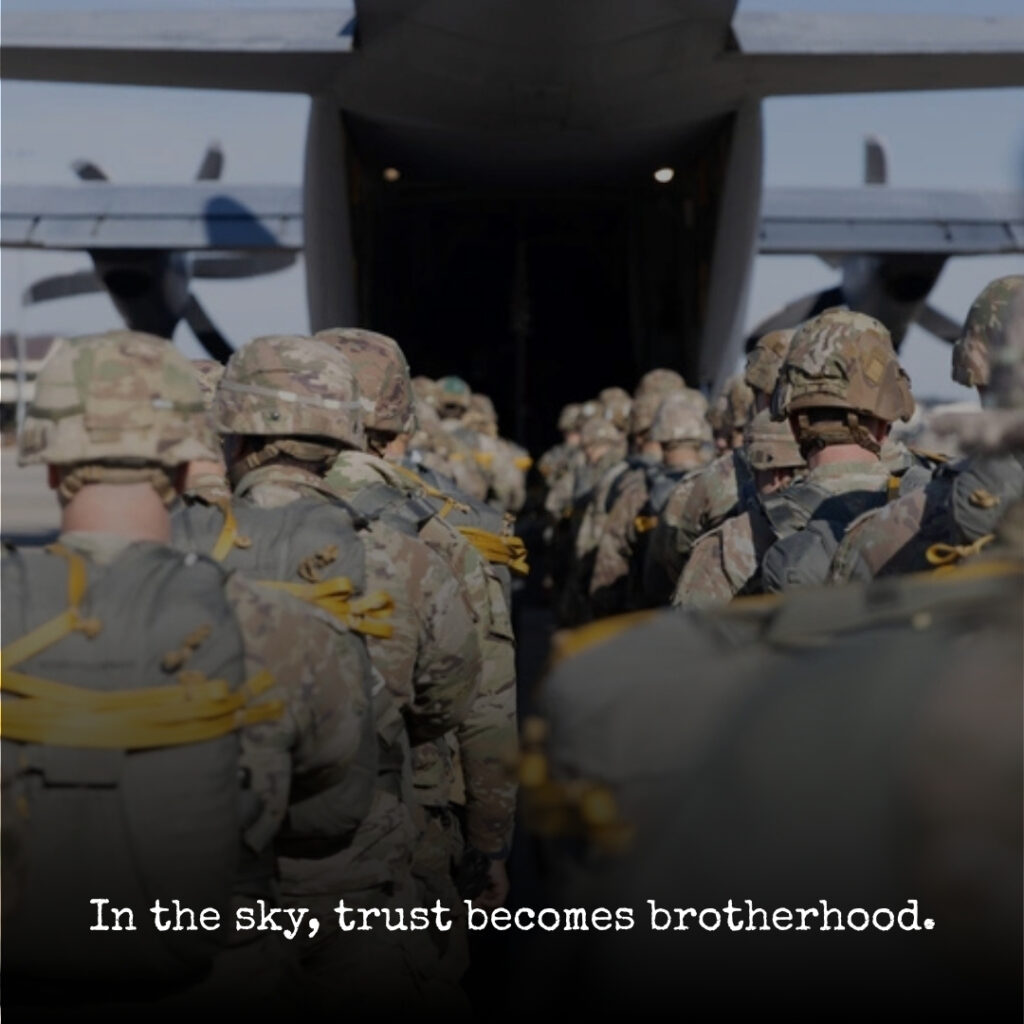
Few experiences create bonds stronger than trusting another person with your life thousands of feet above the earth.
Every Airborne operation depends on teamwork. Every jump requires confidence that the Soldier beside you has trained just as hard and is equally committed to accomplishing the mission. That shared responsibility creates friendships that often last a lifetime.
Ask an Airborne Veteran about their service, and they may not begin with medals or promotions.
They’ll remember jump numbers. Drop zones. The smell of jet fuel. The sound of static lines snapping tight. The nervous laughter before exiting the aircraft. The relief after seeing another parachute open. And the friends whose boots touched the earth for the last time.
Those memories never fade. They simply become part of who they are.
Today’s Airborne Legacy
Modern warfare has evolved dramatically since those first experimental jumps in 1940. Aircraft are faster. Equipment is lighter. Communications are nearly instantaneous. Precision technology has transformed how today’s military fights.
But one thing has never changed.
Someone still has to stand at the open door.
Someone still has to silence every instinct telling them to stay inside.
Someone still has to trust their training enough to take that first step into empty sky.
Technology cannot replace courage.
It never will.
Today’s Airborne Soldiers continue to train relentlessly because they know that when the nation calls, hesitation is not an option. They inherit not only advanced equipment, but also the expectations, traditions, and sacrifices of every paratrooper who came before them.
Why We Celebrate National Airborne Day
National Airborne Day is not simply about remembering a military milestone.
It is about honoring Americans who willingly accepted extraordinary risks so others would never have to.
It reminds us that freedom has often depended upon ordinary people making extraordinary decisions. Decisions to volunteer. Decisions to endure impossible training. Decisions to jump into darkness so future generations could live in the light.
Most Americans will never know what it feels like to stand at the edge of an aircraft door thousands of feet above the earth, carrying nearly a hundred pounds of equipment while preparing to leap into uncertainty.
Airborne Soldiers know.
They accepted that responsibility for all of us.
Jumping Into History
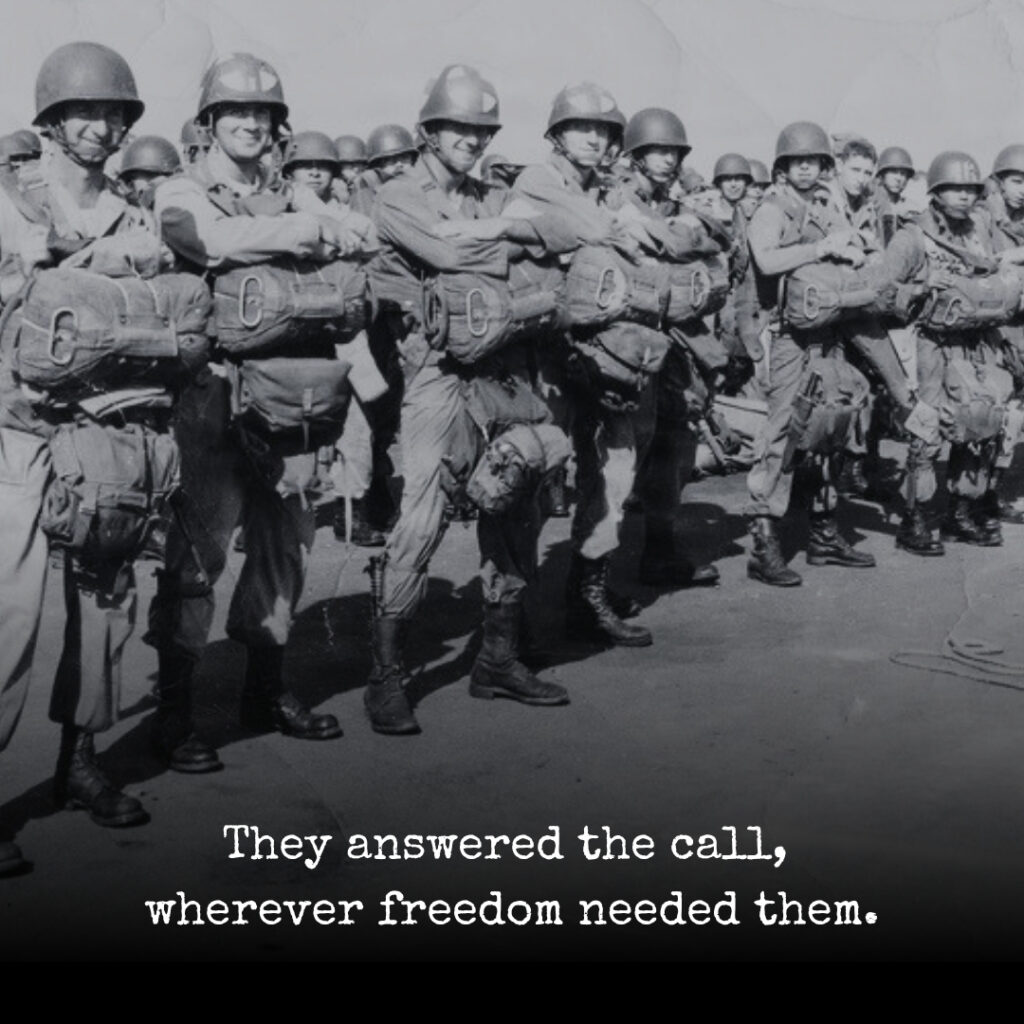
History remembers dates. It remembers battles. It remembers victories.
But history is ultimately written by people. People willing to take the first step when no one else will.
On August 16, as we celebrate National Airborne Day, let us remember the forty-eight volunteers whose courage gave birth to America’s Airborne Forces. Let us honor the thousands who followed them into the skies over Normandy, Korea, Vietnam, Panama, Iraq, Afghanistan, and countless other places where freedom called.
Remember those who came home carrying memories that few could understand.
Remember those whose final landing was on foreign soil.
And remember those who still stand in aircraft today, waiting for the green light.
Because every time an Airborne Soldier steps into the open sky, they are doing far more than making a parachute jump.
They are carrying forward a legacy built on courage, sacrifice, and an unwavering commitment to defend the freedoms we cherish.
Some people spend their lives searching for history.
America’s Airborne Heroes chose to jump into it.
Airborne.
All the Way.
About the Author

Mike Isaac-Jimenez is a 25-year U.S. Air Force Veteran based in San Antonio, TX. He currently serves as a Marketing and Communications Contractor with Soldiers’ Angels, where he shares his passion for storytelling with his dedication to honoring military service. Mike holds a B.S. in Technical Management (Project Management) from Embry-Riddle Aeronautical University, along with A.A.S. degrees in Mechanical & Electrical Technology and Mechanical Engineering. He writes to preserve the legacies of America’s heroes and honor those who served and are still serving.