When the Flag Is Folded: The Deeper Meaning of Respect
June 9, 2026
There is a moment in every patriotic observance that does not announce itself loudly. It does not ask for attention. It does not compete with applause, speeches, or music.
It happens after all of that.
It happens when the flag is folded.
Not when it is raised high into the sky. Not when it waves boldly in the wind. Not when it is carried through parades or displayed above homes, schools, and public buildings.
It is when it is carefully brought down, corner by corner, crease by crease, until it becomes something small enough to be held in two hands.
That is when people stop talking about respect and start showing it.
This is the Meaning of a Folded Flag.
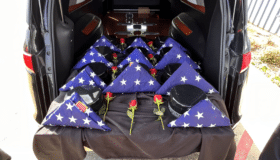
Whether people fold the flag during a Flag Day observance, a military ceremony, a Veterans event, or a final farewell to a fallen hero, they honor a meaning that reaches far beyond tradition.
Flag Day is often described as a celebration of symbolism. People talk about colors, origins, and history. Red for valor. White for purity. Blue for vigilance, perseverance, and justice.
But none of that fully explains why people instinctively fall silent as honor guards fold the flag. None of it explains why Veterans straighten their posture. None of it explains why families pause and reflect. None of it explains why silence often becomes the most powerful part of the moment.
Because the meaning is not in the fabric.
It is in what the fabric represents.
The Weight That Does Not Look Heavy
To the eye, a flag is light. It moves easily. It bends with the wind. It does not resist.
But what it represents is not light at all.
It carries generations of Americans who answered a call greater than themselves. It carries stories of courage that never made headlines. It carries memories of sacrifice, service, perseverance, and hope. It carries the dreams of those who built a nation and the determination of those who defended it.
So when people fold the flag, they do more than shape a piece of cloth.
It is history being handled with care.
This is the Meaning of a Folded Flag.
Each fold serves as a reminder that freedom did not appear on its own. Generations of ordinary people stepped forward and protected the freedoms we cherish today.
And that is why the folding is slow. Not because it has to be.
But because it should be.
The Silence That Speaks Loudest
There is a kind of silence that feels empty.
And then there is a kind of silence that feels full.
The folding of the flag belongs to the second kind.
In that silence, people are not thinking about a piece of fabric. They are thinking about what it stands for.
A grandfather who served during wartime.
A mother who wore the uniform with pride.
A father who deployed far from home.
A generation that endured hardship so the next generation could live in freedom.
The flag connects Americans to the people, sacrifices, and stories that shaped our nation.
And no one rushes that moment because everyone understands something unspoken.
Respect is not loud.
Respect does not need to explain itself.
Respect stands still.
That is the Meaning of a Folded Flag in its quietest form.
The Hands That Fold and the Hearts That Understand
There is a discipline to folding a flag. It is precise. It is practiced. People do it the same way every time, no matter who is watching.
But behind that precision is something much deeper.
The people folding the flag understand they are participating in a tradition that connects generations of Americans.
They know they are handling a symbol that has flown through times of peace and times of conflict. Through triumph and tragedy. Through moments that shaped the nation.
Because no one truly watches a flag fold without reflecting on what it represents. Somewhere in that moment, there is always a memory.
Always a lesson.
Always a story.
The Meaning We Were Never Taught in School
We learn dates.
We learn battles.
We learn historical events.
We learn definitions of patriotism.
But no one often teaches us how to show respect through action.
Respect is not just saying thank you.
Respect is slowing down when something matters.
Respect is standing when others sit.
Respect is removing your hat during the national anthem.
Respect is understanding that every folded flag carries the stories of those who served, sacrificed, and defended the freedoms we enjoy today.
And in that moment, many realize something quietly but clearly.
Freedom is not just an idea.
Each generation passes this responsibility to the next.
The Final Shape Is Not the End
A folded flag is not an ending.
It is a reminder.
It moves from open sky to careful hands. From movement to stillness. From a visible symbol to a personal reflection.
Its shape changes, but its meaning does not.
The folded flag reminds us that patriotism does not belong only to holidays. It does not belong only to parades or ceremonies.
It lives in gratitude.
It lives in remembrance.
It lives in the decision to honor the values the flag represents every day.
And that is why the final shape matters.
Because it transforms a familiar symbol into something deeply personal.
What We Are Really Watching
When people gather for Flag Day, they often think they are watching a tradition.
But what they are really witnessing is a conversation between the past and the present.
Every fold says something without speaking.
This history matters.
This service matters.
This sacrifice matters.
This nation remembers.
And even those who do not fully understand the tradition feel something settle inside them when it ends.
Not pride alone.
Not gratitude alone.
But something deeper.
A recognition that respect is not a feeling we visit once a year.
It is a responsibility we carry forward.
The Flag Does Not Speak, But It Teaches
The flag does not explain itself.
It does not argue.
It does not demand.
It does not insist.
But when people fold the flag, it teaches without words.
It teaches that honor is not always visible.
It teaches that people do not always speak their gratitude.
It teaches that people treat the most meaningful things in life quietly, carefully, and with full attention.
And it teaches something even more important.
That freedom has a human story behind it.
Every single time.
The Moment That Stays After the Observance Ends
Long after the crowd leaves and the music stops, the memory of the folded flag remains.
It shows up later in unexpected moments.
In classrooms where teachers teach history.
In family gatherings where people share stories of service.
In a community event honoring Veterans.
In a quiet reflection on what it means to be an American.
Because respect does not end when the observance ends.
It continues in how we remember.
It continues in how we speak about those who served.
It continues in whether we choose to appreciate the freedoms we have inherited.
A Flag Day Reflection
On June 14, millions of Americans will see the flag flying proudly against the sky.
Many will admire its colors.
Many will remember its history.
Many will celebrate what it represents.
But perhaps the deeper lesson of Flag Day is found not when the flag is flying.
Perhaps it is found when the flag is folded.
Because in that quiet act, we are reminded that respect is more than a gesture.
It is more than tradition.
It is more than words.
It is gratitude expressed through action.
It is remembrance carried forward.
It is an acknowledgment that the freedoms we enjoy today were entrusted to us by those who came before.
And when the flag is folded, it asks something of each of us.
To remember.
To appreciate.
To honor.
And to ensure that the values represented by those stars and stripes continue to live on long after the ceremony ends, the observance fades, and Flag Day passes.
About the Author
Mike Isaac-Jimenez is a 25-year U.S. Air Force Veteran based in San Antonio, TX. He currently serves as a Marketing and Communications Contractor with Soldiers’ Angels, where he shares his passion for storytelling with his dedication to honoring military service. Mike holds a B.S. in Technical Management (Project Management) from Embry-Riddle Aeronautical University, along with A.A.S. degrees in Mechanical & Electrical Technology and Mechanical Engineering. He writes to preserve the legacies of America’s heroes and honor those who served and are still serving.