San Antonio’s Battle of the Flowers: Texas history becoming American Tradition
April 11, 2026
As the best non-profit organization for supporting military members, Veterans, and their families (in my opinion, of course), Soldiers’ Angels is appropriately headquartered in San Antonio, TX, a.k.a. Military City USA. The city wears that title proudly and fits perfectly considering it’s had a military presence for over 300 years. With such a rich cultural and military history, city-wide traditions take place annually to honor the battles fought and the legacy they’ve left behind, such as the Battle of the Flowers Parade, the founding tradition of Fiesta San Antonio.
This is not just a parade. It is a tribute to sacrifice, a celebration of identity, and a powerful reminder of the deep military roots that helped shape Texas and the nation.
The Origins: A Tribute Born from Remembrance
The story of the Battle of the Flowers begins in 1891, when a group of San Antonio women came together with a shared purpose: to honor the fallen heroes of the Texas Revolution.
Led by civic-minded organizers like Ellen Maury Slayden, these women envisioned a public event that would commemorate the defenders of the Alamo and the victory at the Battle of San Jacinto. April 21—the anniversary of San Jacinto—was chosen as the symbolic date, connecting the celebration directly to the moment Texas secured its independence.
The first parade was unlike anything the city had seen. Participants traveled by horse-drawn carriage, bicycles, and on foot, all adorned with flowers. When they reached the Alamo, something spontaneous and unforgettable happened—participants began throwing flowers at one another.
That moment gave the event its name: “The Battle of the Flowers.”
What made this origin so powerful was its intention. This was not a festival created for entertainment—it was created for remembrance. The flowers symbolized both celebration and mourning, a duality that still defines the event today.
From a Single Parade to Fiesta San Antonio
The first Battle of the Flowers Parade sparked something much larger; It was the beginning of a legacy. By 1895, the event had expanded into a multi-day celebration that included festivals and cultural gatherings that still take place to this day.
This evolved into what is now known as Fiesta San Antonio, a citywide celebration that spans more than a week and includes over 100 events.
At the center of it all remains the Battle of the Flowers Parade—the event that started everything.
Today, Fiesta attracts millions of visitors and raises significant funds for local nonprofits, reinforcing its identity as a “party with a purpose.” Some local businesses even have time off scheduled for their staff to participate in the festivities.
Despite its growth, the parade has retained its original mission: to honor history while bringing the community together.
What the Battle of the Flowers Is Today
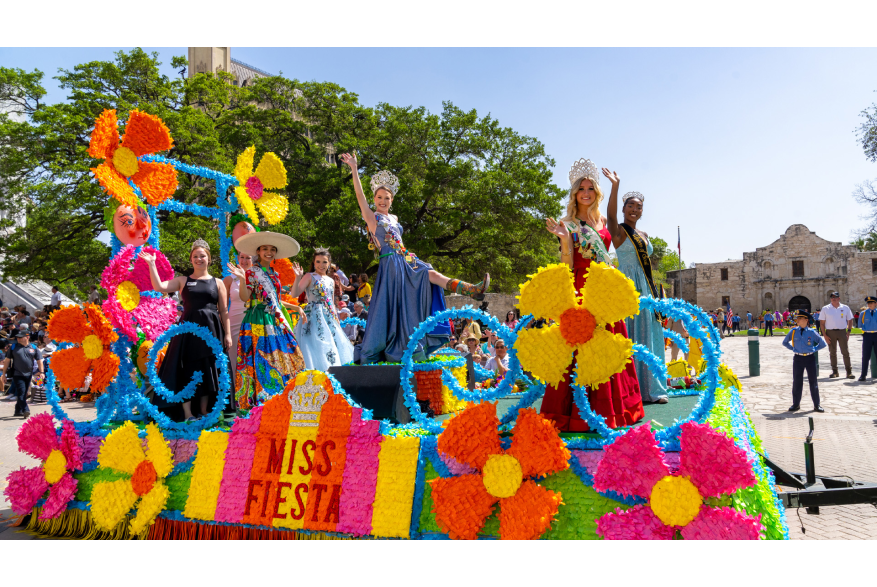
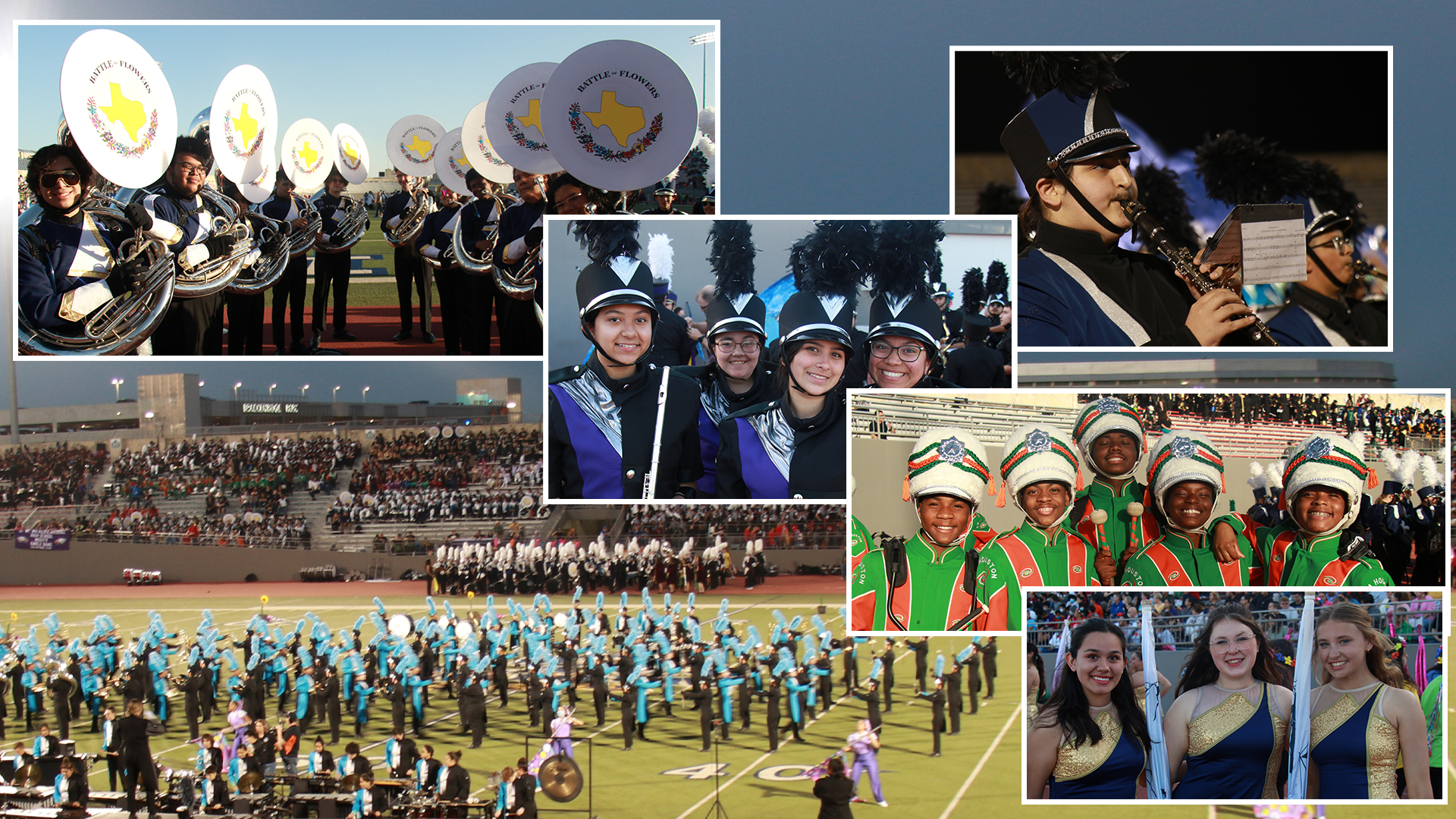
Today, the Battle of the Flowers Parade is one of the largest parades in the country, drawing crowds of more than 350,000 spectators each year.
It is also unique in a way that sets it apart nationally: it is the only major parade in the United States produced entirely by women, organized by a volunteer association dedicated to preserving Texas history and civic pride.
The parade features:
- Elaborately decorated floats
- High school and collegiate marching bands
- Military units and ceremonial groups
- Fiesta royalty and cultural ambassadors
- Cavalry units and equestrian performances
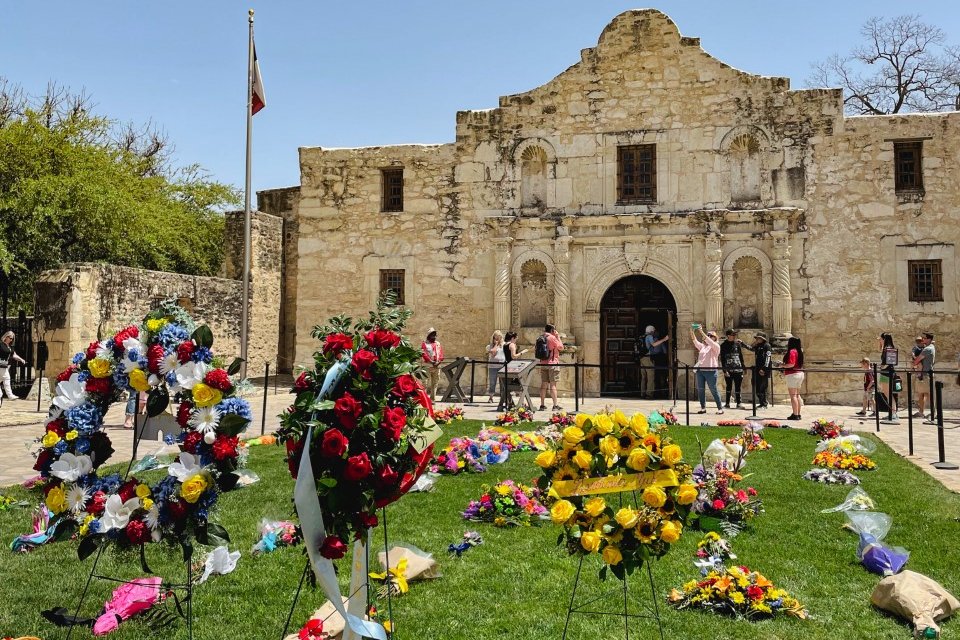
One of the most enduring traditions is the wreath-laying ceremony at the Alamo, where participants pause to honor those who gave their lives in the Texas Revolution.
For many San Antonio residents, this day is more than an event—it’s a local holiday. Schools close, families gather, and generations line the streets to watch a tradition that has endured for over a century.
The Deep Military Connection
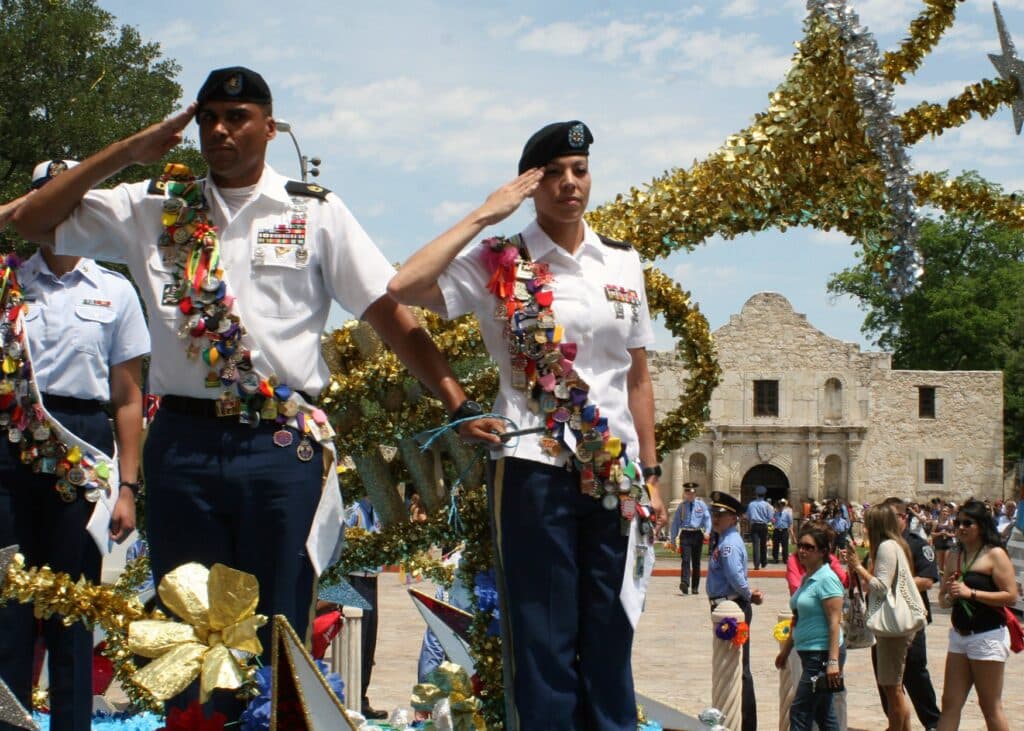
At its core, the Battle of the Flowers Parade is inseparable from military history. It was founded specifically to honor those who fought and died in key battles that shaped Texas:
These events are not distant memories in San Antonio—they are part of the city’s identity. The Alamo itself serves as both a physical and symbolic anchor for the parade, reinforcing the connection between past sacrifice and present celebration.
Honoring Service Through Tradition
From its earliest days, the parade has functioned as a public act of remembrance. The original flower-throwing was symbolic—an offering of respect and gratitude. Today, that symbolism continues through ceremonies, tributes, and participation by military members.
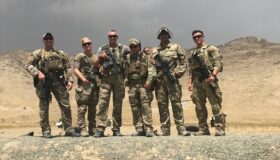
Modern military involvement is active and visible. Units from Joint Base San Antonio (JBSA) regularly participate in the parade, marching alongside civilians and reinforcing the city’s nickname: “Military City USA.”
Sailors, Soldiers, Airmen, and Veterans all take part, bridging the gap between historical and contemporary service.
A City Built on Military Presence
San Antonio’s identity as a military hub strengthens the connection even further. With installations like Fort Sam Houston, Lackland Air Force Base, and Randolph Air Force Base, the city has long been a center for training and supporting U.S. Service Members.
The Battle of the Flowers Parade reflects this reality. It is not simply remembering military history—it is actively engaging with a living military community.
Conclusion: A Living Legacy
The Battle of the Flowers Parade is more than a spectacle—it is a living legacy.
It began with a simple idea: to honor those who gave everything. That idea has grown into a citywide celebration that blends remembrance, culture, and community into something truly unique.
Every float that passes the Alamo, every wreath laid in silence, and every Service Member who marches in uniform is part of a story that began in 1891—and continues today.
In San Antonio, history is not just remembered. It is celebrated, honored, and carried forward—one flower at a time. If you want to be part of Military City USA, and honor those who are serving today, right now, consider volunteering with us by sending care packages, writing letters to deployed, helping low-income Veterans locally, and much more, then Click here!
About the Author

Adrian Martinez is currently the Marketing and Communications Manager for Soldiers’ Angels. He served in the U.S. Navy for 4 years and graduated from The University of Texas at San Antonio in 2021.